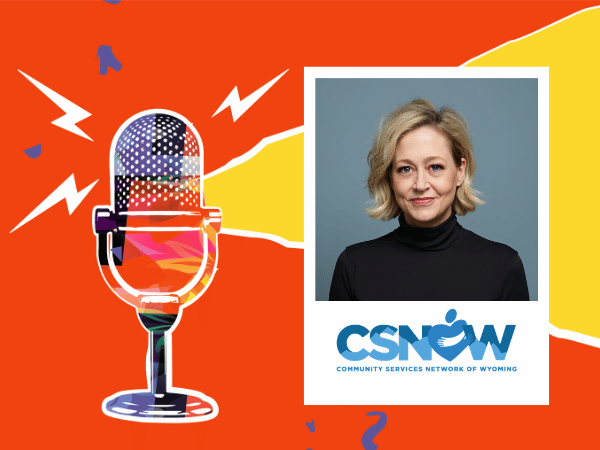
Susan Carr didn’t set out to become a grantwriter.
She studied education in college, never taught a day in the classroom, and spent her early career as a publisher overseeing a group of small community newspapers across the Western states.
But looking back, her path from publisher to fighting poverty with the Community Services Network of Wyoming makes complete sense.
“I learned what it was like to be involved in your community. Hyper-local news. That experience helped me to tell narrative stories in grant applications about what we were doing, and the impacts we were making.”
Her instinct to get close, listen, and tell the story of what’s actually happening on the ground turned out to be the most valuable thing she’d bring to the nonprofit world.
She just didn’t know it yet.
What “Teach a Man to Fish” Doesn’t Cover
When asked about poverty in broad terms, Susan doesn’t accept the simple framing. Yes, it’s about giving people a hand up rather than a handout. Yes, it’s about moving people toward self-sufficiency. But the teach a man to fish metaphor only goes so far.
“What happens if your community doesn’t have a pond to fish from? What happens when the only pond is polluted? Then what? That’s when you start getting into systems and systems change.”
Community action is built on a deceptively simple premise: poverty is best understood and addressed at the community level, not from Washington.
Decisions shouldn’t flow down from the Department of Health and Human Services. Rather, they should come from governing boards that are required, by law, to include people with lived experience of poverty.
“Communities get to decide how they’re going to combat poverty,” Susan explains.
In practice, that means standard assumptions about what people need get tested, and sometimes overturned, by the people who know best. She has a story about that.
As required by the Federal Community Services Block Grant, her organization conducted a community needs assessment, surveying both service providers and people with lived experience.
The two groups had wildly different answers.
“The people providing services said, ‘Hey, if we just teach them to budget their money, maybe give them some financial planning classes, they’ll be fine.’ People with lived experience said they need dental care.”
At first, that answer may sound surprising. How can the dentist help fight poverty? But the more you look, the more it makes sense.
“If you have a bad tooth and it gets pulled, you miss work. Typically, you’re at a job that doesn’t have sick days, so you either go to work in pain and be less productive, or you call out sick and don’t get paid for that day or even lose your job. It’s a vicious cycle.”
Armed with that information, Susan wrote a grant to fund dental services for low-income individuals.
The outcome?
Within a year, 65% of people who used their services had higher-paying jobs. Roughly a quarter permanently left poverty altogether.
“Is it only because they got dental care? No,” she’s careful to say. “But it was the beginning of them becoming more self-sufficient.”
The Grant Toolbox—and Why You Need One at the Ready
The current funding climate is tough. Susan is well aware.
Federal grants have shifted dramatically in the last year, and funding opportunities that once allowed six weeks for preparation now sometimes give applicants just a few days.
“In my opinion, impossible deadlines are one way an administration can make sure they’re not spending money they don’t want to.”
And private foundations, even well-endowed ones, are being overwhelmed by demand they were never equipped to absorb.
“Even Bill Gates came out and said, ‘You’ve got to be kidding me. We cannot make up the difference of what the federal government used to fund.’”
Her response isn’t despair. It’s preparation.
“You'd better be ready to write a grant at a moment’s notice,” she advises.
She keeps what she calls a “grant toolbox” at the ready: a folder of ready-to-go narrative, pre-defined outputs and outcomes, budget templates, and documentation that answers the questions every grant—federal, state, or private—will eventually ask. That way, when a funding opportunity drops with a 72-hour window, she can move.
Being ready is as much about strategy as it is about preparation, too.
“It’s really tempting to throw as many applications out there as you possibly can, just to see if something sticks. But you can’t be all things to all people all the time. When you don’t align with donor profiles, or what they’re trying to accomplish, that’s just lazy grant writing.”
The Story Doesn’t End With the Output
The trick with grant writing is combining the head with the heart. And when it comes to grant applications, there’s a specific data-oriented failure mode Susan returned to repeatedly during our conversation.
Organizations, and even the feds, confuse outputs with outcomes.
“I don’t care how many pounds of food went out the door. What changed because you had a food pantry? What was the change in behavior? The story needs to continue with systems change, and those are the important questions nobody is asking.”
This extends from application to grant stewardship as well.
“Even if your funder doesn’t ask for one, I would give them a six-month and a one-year impact report. They want to know exactly what their money did, and it’s going to make you more likely to be invited to apply again.”
Near the end of the conversation, Susasn circled back to the dental grant story. Not because of the outcome numbers, impressive as they are, but because of what the process represented.
“When you’re strategic and have a good plan on how you’re going to execute, and how you’re going to make a difference in people’s lives, that’s the greatest thing about writing grants. The dental story is one of my favorites because we took survey data, made a data-driven decision, used that data to apply for appropriate grants, got the grants, and did the work.”